
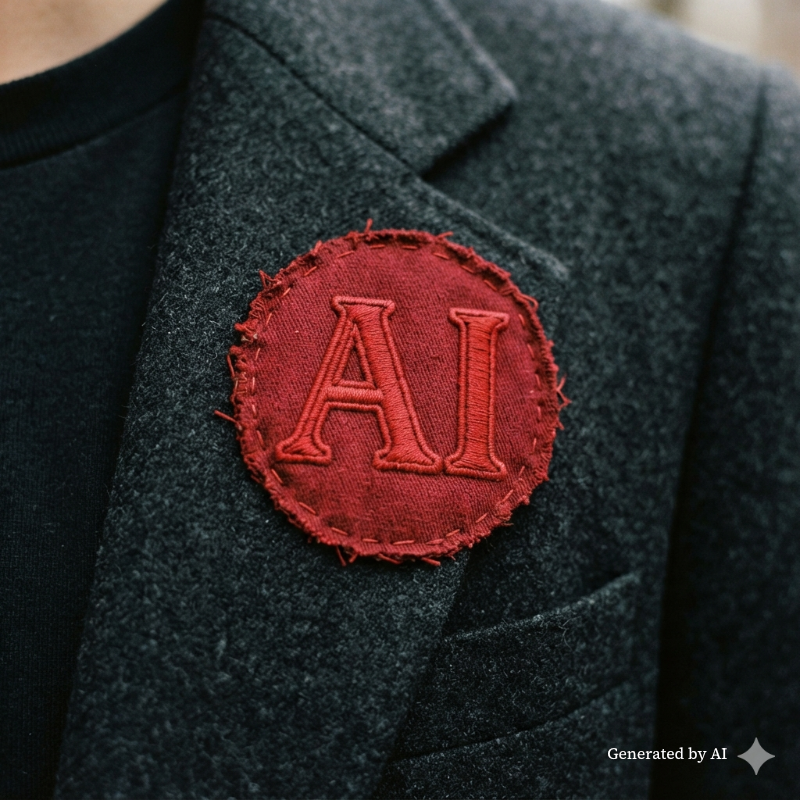
After the social media folks took their whacks at the menace of AI slop, Anthropic fired yet another shot by announcing it’s adding a watermark to any text generated or processed by Claude.
The move is a response to a new EU law that requires identification of AI-generated or manipulated material, so people can react with a skeptical eye accordingly. In theory, it’s supposed to apply to any AI model available there. So … in theory … OpenAI, Meta, Microsoft, Moonshot, Alibaba, et. al should soon follow suit. And not just with their new models. With all the models that haven’t been retired.
Before you break out the popcorn for the widespread public shaming and banishment of AI ne’er-do-wells that’s about to commence, I regret to remind you that this law only has teeth if:
- Each one of those companies takes it seriously, and doesn’t just give it a wink and a nod.
- Each one of those companies follows Anthropic’s lead and applies it globally, and not just in the EU.
- Their own getting-smarter-all-the-time models can’t be hacked to undo whatever method they or their competitors use to set their respective watermarks.
- The entire world agrees to delete all their existing open-weight models and start fresh with watermark-capable counterparts.
- The entire world rejects any material that’s watermarked, regardless of whether it’s truly slop.
How likely are any of these scenarios? Go on, I’ll wait for you to think it through.
Yeah. Not very. It will be incredibly easy for anyone to circumvent this law and claim “authentic” if they can manage not to betray themselves with slop.
Thus, while there’s been much rejoicing over this move, it’s a moral victory. The sloppers might have been pushed out of a few channels, but they’ll persist. Especially in sketchy backchannels for nefarious purposes, which is one of the situations the EU law was trying to squelch.
Overly broad brush
As much as I detest deepfakes, non-consensual exploitation, AI-written novels, and their ilk, the toothpaste is out of the tube on this.
That’s not to say we should give up on AI transparency measures. And, just like the EU, U.S. states are rolling out laws aimed at keeping their constituents from getting duped by AI-generated material. Big AI providers like Google and Microsoft have had related transparency technologies for at least a year, but generally geared more toward images and video (or at least that’s what they say publicly). Google is the exception, having applied its SynthID technology to text in Gemini as well as media. Anthropic is using a variant of SynthID, in fact.
Reliable transparency measures can also help in situations where the doer of the work needs to be validated independently, such as a school essay. AI detectors, like the plagiarism detectors before them, have been attempting to solve this problem, but they still flag a lot of false positives.
Reliable, as Claude would say, is therefore doing a lot of work in my previous sentence. If a model’s watermark technique can only surface that AI “was likely involved with the content at some point,” then how does the average person determine the balance between the creator’s level of involvement and the AI’s if the creator doesn’t disclose it, intentionally or otherwise?
Anthropic’s new watermarking, for example, will show up in fully-generated text as well as text Claude only edits. The exact threshold for how much is too much Claude remains murky. But the folks who rely on Claude to polish their original ideas are now at risk of being branded with the same Hater of Humanity label as someone who used it to write the whole thing.
What if the person’s a non-native language speaker and is using AI to communicate better? What if they edited out the slop and hallucinations and the final product ably serves its intended purpose (like, say, technical documentation)? What if the creator used AI to repurpose their 100%-human work for a different channel or format?
These are the ways AI was supposed to boost our personal productivity. Arguably, they’re the right approach. AI helping humans be better at what they do.
Are people abusing the technology? Hell, yes. They’re humans. That’s what we do.
Yet the folks trying to do this the right way are being found guilty by association. Even if they’re fully upfront about their AI use, there’s a non-small segment of the population that will bestow upon them The Taint of supporting greedy corporations, polluting datacenters, and the rampant IP scraping that trains the models.
It feels like we’re forcing them to hide their use, which is the exact opposite of transparency. Even Google is backtracking a bit with its announcement that it will allow users to turn off the visible sparkle icon on generated images and video. (The invisible watermark will remain, however.)
“This is fake” becomes a badge of honor
Don’t get me wrong. I’m not trying to go all Zuckerberg “The Future is for Everyone” here. (Not linking to that essay. Deliberately.)
There’s no excuse for presenting slop in any sort of serious context; AI is having a detrimental effect on many parts of society; and the deepfakers and exploiters and con artists of the world will keep on keepin’ on until there’s no incentive not to. We do need government regulation to get a handle on this mess, but solutions that are either unenforceable or lump everyone together into an “AI is bad” bucket ain’t it.
In the short term, creators using AI for above-board reasons will need to maintain their credibility by disclosing what is and isn’t real. The fake photo your audience knows is fake will be more trustworthy than the photo that’s purportedly human-made but seems off.
There’s nothing we can do about the less-than-above-board creators, though. And any AI use in certain circles — for example: books, art, and now social media — will continue to get the stink-eye regardless of how transparent you are. That’s also unfortunately where the public shaming will thrive, justified or not. Know your audience and make changes accordingly.
There’s also a risk that creators who are well-intentioned about responsible AI use can accidentally over-immerse themselves in the technology and not realize when they’ve veered into slop territory. It’s easy to get caught up in the wow factor with AI, and we’re learning more and more that it shapes our behaviors and thought processes in ways we never expected. Not always for the better.
If these watermarks and all the other anti-slop measures get people to stop and consider those influences, that’s the true victory.
You’ve only got one brain. Don’t outsource it.
All opinions here are my own. All text is my own, too, including the em dashes. I welcome constructive comments and discussion on LinkedIn and Bluesky.
Leave a Reply