
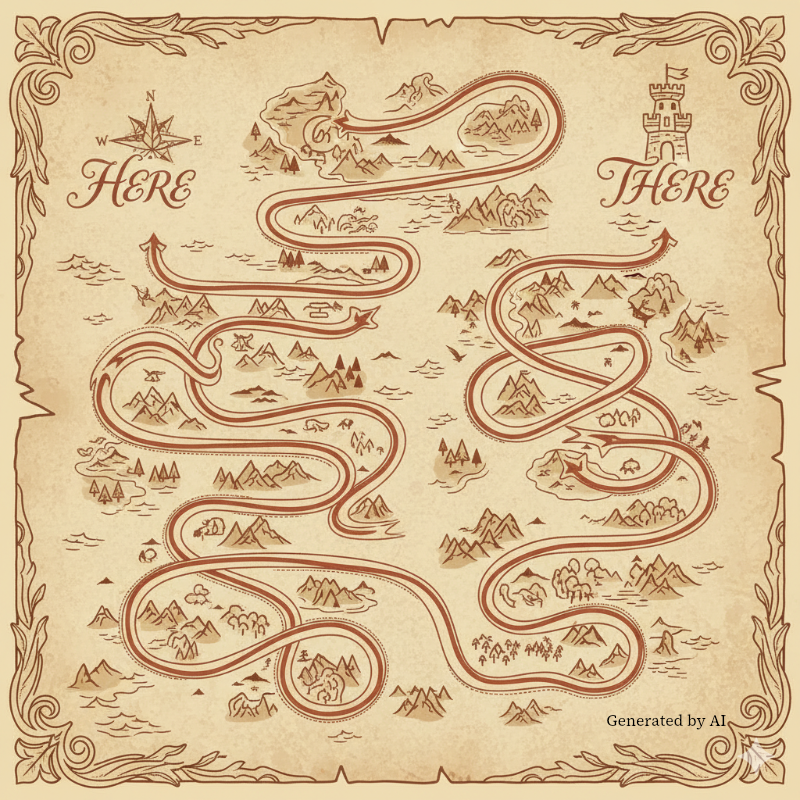
I learned about a year ago that making detailed strategic plans had become an exercise in futility.
It started with corporate acknowledgement that the stalwart annual operational planning cycle that was a big part of my role for six months each year was … not a thing anymore. Or at least not a thing except for the really high-level business units where you have to have more structure to manage the Finance bits.
I mean, I don’t fault that decision. My org’s previous operational plan had gone stale in approximately 2 weeks. And we weren’t the only ones.
It’s only gotten worse since then, to the point where I’m finding it futile to formally map out even low-level projects. AI makes it easy to churn out revisions now, but it’s still tough to keep track of all the other revisions going on simultaneously, not to mention the dependencies that evaporated, the timelines that got sped up, and the workstreams that pivoted all their deliverables.
This, my friends, is the new normal. And the most interesting part is that it’s a matter of AI shaping and evolving human behaviors instead of the other way around.
Last week, we covered how organizational AI literacy starts at the top and leaders set the tone for change. The next part of my framework (see overview) lays the groundwork for moving from leadership strategy into front-line execution.
Taking a cue from Agile
Let’s take a trip into Agile methodology, shall we? You’re probably already familiar with the term, or have at least heard it, but here’s the manifesto if you wanna deep-dive. It was designed for software development but has since crept across project management in general, too.
At its core, Agile involves breaking big things down into small pieces that can be delivered in short, time-boxed series of work. The thinking is that you can move faster and end up with a better product when you continuously deliver pieces of it and iterate as you build, vs. the waterfall method of one-big-delivery at the end. Those one-big-delivery plans tend to face a lot of delays because of scope creep or unforeseen requirements that crop up midway through. In theory, Agile is flexible enough to absorb the extras without the timeline-busting do-overs.
My biggest beef with Agile is that it focuses so heavily on the pieces that it often misses the big picture. In some company cultures, it’s also a convenient excuse for delivering an “MVP” product instead of something fully baked, either for the sake of calling a goal complete or because there’s a shiny new toy everyone wants to pick up instead. Enshittification is one of the consequences.
Funny enough, AI also can focus so heavily on the pieces (i.e., its current prompt) that it misses the big picture (i.e., what in the blessed hell you’re trying to get it to accomplish). So the recommendation when you’re building or automating with AI is a prompt chain: give the AI a straightforward summary of your end goal and then prompt it to 1/ ask you clarifying questions until it gets the context it needs; 2/ figure out its own path to deliver your goal; and 3/ iterate with you until you’re happy with the result.
In this scenario, you’re a leader who’s actively guiding, co-designing, and orchestrating your automated engineering squad, then holding them accountable for meeting your expectations. Sounds a lot like a human team, right?
This is also pretty Agile, frankly. Especially when you enter the matrix and start spinning out a bunch of sub-agents to complete different workstreams simultaneously. And you don’t really need to time-box because, well, it all happens relatively fast.
The collaborative future at scale
This is also how cross-team and cross-functional work will happen going forward. It’s not possible anymore to design long-range operating plans that articulate in detail what the objectives are, how everyone will collaborate, how they’ll accomplish goals, and the exact timeline they’ll follow. Well, you could, but it would be a lot of wasted effort.
Leaders will establish a strategic vision (the summary of the end goal) and then parse it out to their teams. Teams of humans and agents will continuously gather and analyze data to understand context, and then they’ll decide how to act on it to meet the goal. Rapid delivery cycles keep the data flowing so you can monitor results and iterate on what’s next. And the whole thing will have built-in guardrails that maintain integrity and continuously improve the system.
Agentic technologies make this a lot easier at scale, but bear in mind there’s a lot going on all at once. You’ll need to make sure humans stay in the loop as supervisors and decision-makers, and these aren’t always technology-driven.
Orchestration
When a bunch of teams are off delivering like gangbusters in different workstreams, they’ll drift off course without a periodic reminder of the end goal and progress toward it. Human orchestrators still need to guide this. We call it business operations (cough my domain), and it’s the hall monitor and accountability driver.
Governance
Just because you’re delivering a lot of stuff doesn’t automatically make it good stuff. Teams still need clear expectations of what “good” looks like, what the cross-team collaborative standards are, and what the organizational boundaries are (budget!). These guardrails are then baked into team-level processes as well as constraints and evaluation loops that keep your automations and agents on track.
Flexibility
We can’t take it personally or throw up a lot of bureaucratic hurdles when work needs to change midstream. Think of it like hitting your chatbot’s stop button midway through its execution and inputting new context that wasn’t there before. Sometimes this might be an advancement in technology. Sometimes your customers’ behaviors are evolving faster than you thought. And sometimes you simply realize you were working on the wrong solution.
Keep your eyes on the prize
The speed of working with AI can make all this seem like controlled chaos, which is unsettling for the folks who’ve been relying on the crystal-clear roadmap. But it’s a sign your org is doing something right. You’re acknowledging the pace of change, adapting, and thinking through your operational systems in ways that support human-AI collaboration.
However … you do have to be mindful of not devolving into actual chaos. AI magnifies existing complexity and operational weak spots that aren’t easy to untangle. While you work through it, you’ve got to have firm conviction in where you’re going, and regularly reiterate your destination. Maybe it’s delivering a product. Maybe it’s moving the needle on a Key Performance Indicator. Maybe you want to grow a customer segment. It can be a lot of things, as long as it’s:
Single
Condense your vision to a singular end result. If it’s a product launch, that’s an easy one. If you’re trying to drive metrics, why those particular metrics? What outcome are you hoping for? Meaning, if X metric improves, then it’s because customers are doing Y. And so your end result is what the customers are doing, not the move in the numbers.
Simple
The crisper your vision, the easier it will be to stay focused. You’ll probably end up with something relatively high-level, and that’s OK. You’re deliberately being strategic instead of prescriptive.
Clear
Anyone, even folks not on your team, should be able to easily figure out your ultimate destination. Keep the jargon out of it, and the phrasing straightforward. Avoid open-ended timing so that you set a rough pace for change. You won’t know exact dates, but you can say things like “by Q1 next year…”
If you’re struggling to define the destination, your nearest AI friend can help. Here are a couple examples to get you started:
- <Ding Ding> “By Q1 next year, 10K new customers will be active users of the Widget platform.”
- <Buzzer> “Improve all KPIs by 20%, deliver 6 new features, complete 60% of goals on time, and drive operational excellence.”
Whenever your implementation plans change, the decisions should tie back directly to your end result. “We pivoted [X] because early feedback showed it wasn’t helping [end result].”
One last tip: Your vision/end result/outcome needs to be relatively stable (aka: high-level business-y). If you change your destination as often as you change the path, your team will devolve into that chaos you’re trying to avoid, because there’s no clear direction.
Find it and stick with it, because it will be what holds your human and your agentic teams together as you map and remap the journey.
AI disclosure: My local copy of Gemma served as a technical advisor to sanity-check how I characterized the AI/Agile connection since, y’know, I’d prefer not to be talking out my ass with this. All opinions here are my own. All text is my own, too, including the em dashes. I welcome constructive comments and discussion on LinkedIn and Bluesky.